The Tournament FIFA Won and Lost at the Same Time
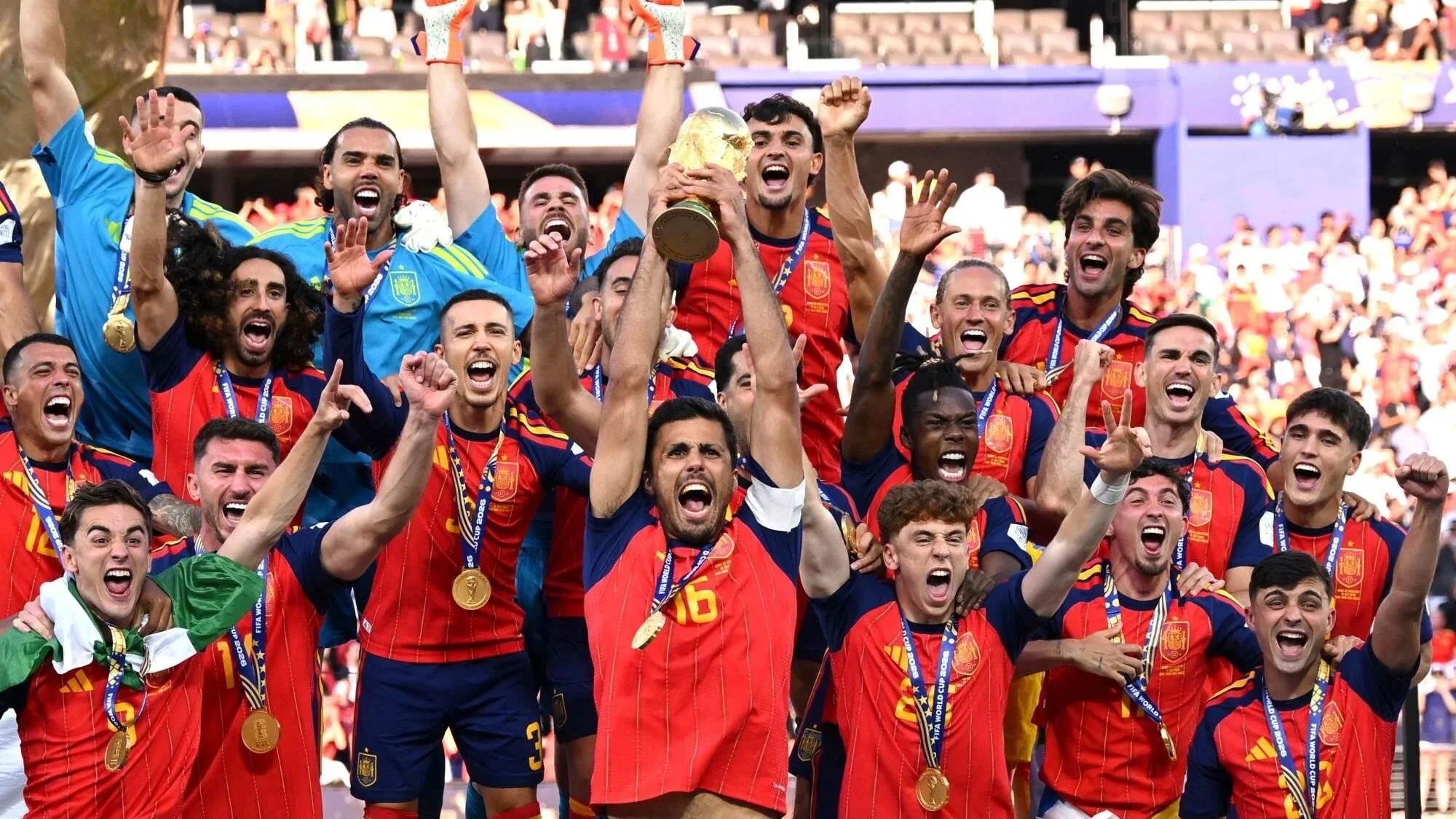
On Sunday evening at MetLife Stadium in New Jersey, Ferran Torres scored in the 106th minute of extra time to give Spain a 1-0 victory over Argentina in the 2026 FIFA World Cup final. Spain's first world title since 2010. Argentina's defense of the trophy ended with Enzo Fernández sent off in the closing stages and a defeat that confirmed Spain as the best national team in the world right now.
The goal was real. The victory was earned. What happened on the stage afterward was something else entirely.
As Spain's players gathered to lift the trophy, FIFA president Gianni Infantino was visibly trying to guide President Trump away from the center of the celebration, his hand gestures indicating clearly that the president should step to his left and allow the players their moment. Trump stayed. The confetti fell. Spain lifted the World Cup beside the President of the United States, who had told reporters before kickoff that he was backing Argentina because it was "hard to bet against Messi."
In the hours that followed, three organizations produced three different versions of what the world had just watched. The White House posted a video of the trophy presentation cropped to remove Infantino's visible attempt to redirect the president. Spain's official social media accounts posted photographs carefully excluding Trump from the frame. FIFA posted an edited version that removed the awkward exchange from its own record of the moment. Subsequently, the White House posted six images from the final, most of which featured Trump prominently, in two of which he is the only person in focus.
Three organizations. Three versions of the same moment. All of them editing reality to suit their own story.
This is where the 2026 World Cup ended. Not with the goal, or the trophy, or a celebration that belonged entirely to a team that had earned it. With a stage that nobody could control and a moment that nobody wanted to own.
How FIFA Got Here
The trophy presentation at MetLife Stadium did not begin on Sunday. It began more than a year earlier, through a series of specific decisions that accumulated into a situation that was impossible to manage when it finally arrived in front of the largest global audience the sport ever reaches.
In December 2025, FIFA held its World Cup draw at the Kennedy Center in Washington at Trump's urging. Infantino created a new annual award called the FIFA Peace Prize and presented it to Trump at the ceremony, praising him for "promoting peace and unity around the world." Trump accepted, calling it "truly one of the great honors of my life." Infantino brought the gold World Cup trophy to the Oval Office. Trump received a personalized FIFA ticket for the final: Row 1, Seat 1.
Months before the tournament began, Infantino publicly confirmed that Trump would co-present the World Cup trophy at the final, calling it a "sacred tradition." The agreement was made, announced, and locked in before a single group stage match had been played.
During the tournament, Trump called Infantino before FIFA reversed its decision to suspend United States striker Folarin Balogun following a controversial red card. Trump said afterward that he had not told Infantino what to do. FIFA lifted the suspension. Balogun played. The United States advanced.
Before the final, Trump told reporters he was backing Argentina. Argentina lost.
Each of these decisions made sense to someone at the time they were made. The Peace Prize was diplomatic protocol for the host nation's president. The co-presentation was a logical extension of the host nation's role. The Balogun call was, officially, a conversation between two leaders of neighboring institutions. Individually, each choice was explainable.
The accumulation was not.
What Proximity to Power Actually Produces
FIFA entered the 2026 World Cup having spent more than a year building the closest possible relationship with the administration of the host nation. The logic was not difficult to understand. A United States president who was visibly enthusiastic about hosting the tournament, who appeared at events, who generated media coverage, who brought the kind of political energy that made the competition feel like a moment of national significance, was a valuable partner for an organization trying to make its largest-ever tournament feel like a global celebration.
What FIFA did not fully account for was what that partnership would look like when the cameras were rolling, the confetti was in the cannons, and the most watched moment of the most watched sporting event in the world was happening in real time.
Institutional independence in sport is not the absence of relationships with powerful people. It is the maintenance of enough distance from any single relationship that the institution can still be seen to serve the sport rather than the relationship. FIFA had been closing that distance for a year. By the time the final whistle blew on Sunday, it had closed it entirely.
Infantino jogging across the stage to redirect the president is the image that captures what that position actually produces. Not control. Not the appearance of authority. A panicked physical intervention that was visible to everyone watching and that the institution subsequently felt compelled to remove from its own official record. If the relationship had been managed with enough distance to be credible, the intervention would not have been necessary. If the intervention had worked, the editing would not have been necessary. The fact that both were required tells you more about what FIFA built over the last year than any statement the organization could issue.
The Three Edits
The editing is worth examining carefully, because it is the most honest communication any of the three organizations produced about Sunday's events.
The White House cropped its video to show Trump presenting the trophy without the context of Infantino's visible effort to move him. This is consistent with how administrations manage official visual records. It is not surprising.
Spain's official social media team posted championship photographs that carefully excluded Trump from the frame. This is the most sympathetic edit of the three. The players earned what happened on that pitch. They should not have had to decide how to manage the political context of their trophy presentation, and the fact that their communications team made that decision for them in the hours after the final reflects how completely the frame around their victory had become part of the story.
FIFA's edit is the most revealing. An institution whose legitimacy depends entirely on its perceived neutrality and independence from political influence chose to remove from its official record a moment that made the absence of that independence visible. The edit is an acknowledgment that the moment was a problem. It is also an acknowledgment that the problem was significant enough to require management. Neither acknowledgment is made explicitly. Both are made by the act of editing.
If the trophy presentation had gone as planned, nobody would have edited anything. The fact that three organizations with different interests and different relationships to the event all independently decided to produce different versions of what happened tells you that what happened was not the version any of them wanted.
What Spain's Victory Deserves
Ferran Torres's goal in the 106th minute is worth separating from everything that surrounded it. Spain played a tournament that peaked exactly when it needed to. They eliminated Argentina, the defending champions, in a final that required extra time and produced genuine drama before the decisive moment arrived. Their squad is built around players at the height of their abilities, playing with a clarity of identity and purpose that made them, across seven matches, the most coherent team in the competition.
Their victory is real. It is theirs. No trophy presentation controversy changes what happened on the pitch over the preceding month, and it would be a disservice to the players and the achievement to allow the institutional story to consume the sporting one entirely.
But Spain's social media team cropped Trump out of their championship photos within hours of the final whistle. That choice was made not because the players asked for it, but because the organization understood that the frame around the celebration had become complicated in a way that should never have been possible. The players should have been able to lift the trophy in a moment that belonged entirely to them. Someone else's decisions made that impossible, and Spain's communications team did the best they could with the situation they were given.
That is the most concrete measure of what FIFA's institutional choices cost: a team of world champions who felt it necessary to edit their own moment of triumph.
What Institutional Independence Actually Costs
There is a version of the Infantino-Trump relationship that is explicable as pragmatic diplomacy. A global organization hosting its largest tournament in a politically active country builds a working relationship with that country's leadership. It creates goodwill, reduces friction, ensures cooperation on logistics and security and the hundred practical dimensions of running a 104-match event across 16 cities in three countries. None of that is unreasonable.
The cost is the thing that is rarely calculated in advance. Institutional independence in sport derives its value precisely from its unconditional nature. A governing body that is independent from political influence when it is convenient and dependent when it is advantageous is not independent at all. It is conditionally independent, which is a different thing entirely, and which the audience for a global sporting event is sophisticated enough to recognize.
FIFA has been eroding its own unconditional independence for decades, through corruption scandals that confirmed the institution could be bought, through governance failures that showed the rules applied differently depending on who was asking, through tournament hosting decisions that made clear commercial and political considerations outweighed the stated principles of the organization. What the 2026 World Cup did was make that erosion visible in real time, during the tournament, in front of the people FIFA most needed to trust it.
The Egypt complaint. The Switzerland manager's comments about playing the referee and VAR. Infantino saying he suffered with Argentina. The all-Argentine officiating appointment. The Balogun call. The stage at MetLife Stadium. The three edits.
None of these events required a conspiracy to produce. They required an institution that had progressively traded the distance required for credible independence in exchange for proximity to power, access to influence, and the appearance of global political significance. That trade produced exactly what trades of this kind always produce: a moment you cannot own and cannot disown, where the only options available are a failed physical intervention and a subsequent editing of the record.
The Institution and the Sport
The 2026 World Cup will be remembered as the tournament Spain won. The football deserves that memory. Forty-eight nations, 104 matches, the largest tournament in history, and at the end of it a team that was simply better than everyone else they faced. That is the sporting story, and it is a good one.
The institutional story will be remembered separately. Not as a scandal in the traditional sense, because no single moment constitutes a clear violation that demands a clean accounting. But as the tournament where FIFA's independence question, which had been accumulating across years of choices that each seemed manageable individually, received its most public and most definitive visible answer.
Not in a courtroom. Not in a boardroom. On a stage at MetLife Stadium, in the moments after the 106th minute, with confetti falling and Infantino jogging and Trump staying and three organizations subsequently producing three different versions of what the world had just watched happen in real time.
Spain are world champions. The trophy is theirs and the achievement is real.
The institution that presided over their victory is still, in the most literal sense, trying to figure out what version of what happened it wants to be seen to have been part of.