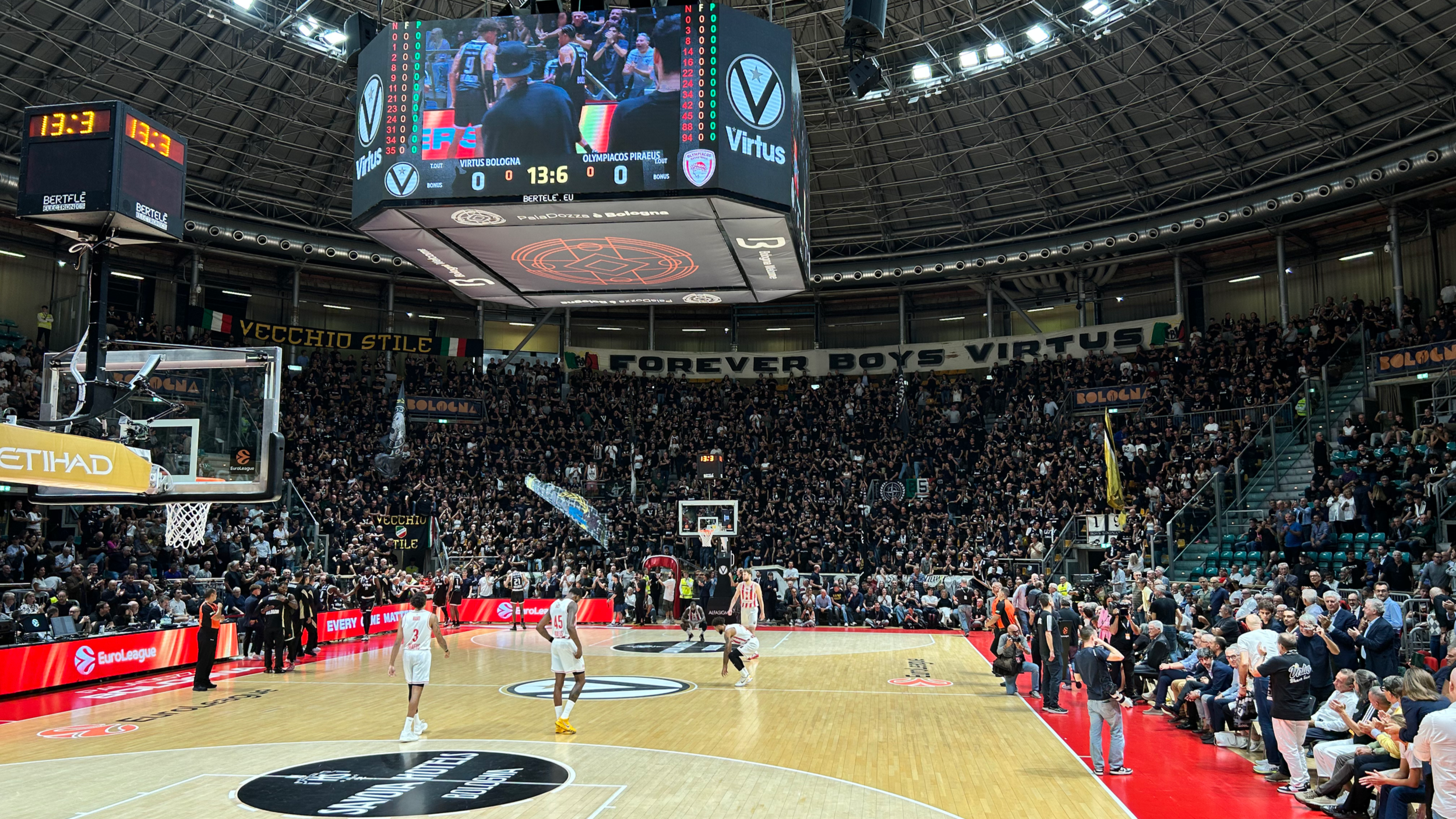
I flew from Amsterdam to Bologna, and by 20:30 that evening I was inside the PalaDozza for round three of the 2026-27 EuroLeague regular season, Virtus Bologna against Olympiacos Piraeus, the reigning champions. It was a short trip with a simple goal, which was to see for myself what basketball in Bologna is about, and the game turned out to be the best I have ever watched live, with the building around it teaching me nearly as much as the result did.
A hall that does not look like an arena
From the outside the PalaDozza does not look like a stadium at all. It stands close to the city center in the middle of a residential area, and the buildings around it make it look like one more building on the street, which is something I had not seen before. It holds around 5.600 people, and Virtus plays its first seven EuroLeague home games of the season there before moving into a new arena of 12.000 seats in December.
What the night showed
The game was fast-paced and elite level from start to finish and it was decided on the last play, with Virtus a point down and Marcus Carr hitting a three-pointer at the buzzer for a 96-94 win over the reigning champions. What stayed with me was the community feeling around it, since a relatively small hall in the middle of a neighborhood makes a crowd feel more like a community than an audience, and the passion of the fans was unmistakable. Atmosphere is one of the things the EuroLeague trades on, and in Bologna it came from the place and the people in it, which I could not have gotten fully from a broadcast or a report.
How I read a club
A club can be read from several sides, including what it has won and how, the way it presents itself, what the people who run it say about it, and what it feels like on a game night. Each side has its own blind spot, since results flatter a club in a good season and punish it in a bad one, a club's own content shows what it chooses to show, and its leaders' words show what it aspires to be. The experience of a game night is the one that cannot be done from a desk, and it is the most useful check on the other three, because a building, a neighborhood and a crowd carry information that nobody has written down. At Narrative Athletics I work from the same principle, which is that an organization is understood best when it is looked at from more than one side.
The same applies well beyond Bologna. Decisions about venues, formats and events are usually made with attendance, revenue and partnerships in view, and those are the right things to look at, but a hall also carries memory, habits and a relationship with the streets around it that rarely appear in a business case, and that are hard to price in advance and easy to lose without noticing.
The question I took home
Standing in that hall, nothing about Virtus needed explaining. The place, the crowd and the way the evening unfolded carried the club's meaning without anyone having to put it into words, which is what happens when an identity has been lived in a city for generations. The question I took home is what happens to that meaning once it leaves the building. A EuroLeague club speaks to people who have never been to Bologna and never sat in that hall, and for them the meaning has to arrive in a form they can grasp without having lived it.
In my research on how EuroLeague clubs express their identity, this is a pattern worth watching in clubs whose identity runs deep. The people closest to the meaning are the least likely to notice that it needs translating, which is less a communications failure than what proximity does to anyone, since what you live in every day stops looking like something that needs to be explained. The work that follows is rarely about inventing anything new, it is about taking what is already real, compressing it into a form that can travel, and making the place it comes from visible to people who have never stood in it.
What carries over to a new home
That makes the move Virtus makes in December interesting from a strategic point of view, as it would be for any club moving into a bigger home. A new arena of 12.000 seats gives a club room to grow, and a bigger hall will bring in more people who never experienced the old one, which means more people for whom the club's meaning has to arrive in a form they can understand. The question that comes with any step like that is which parts of the old building have to carry across for the club to still feel like itself, and how the people who never stood in it get to feel them too. Virtus will have its own answer, and from what I saw on Thursday there is a great deal worth carrying across.
Marcus Carr's shot is what people will remember from that night, and it deserves to be, because it ended an excellent game in the best possible way. What I will remember is the place it happened in, an old hall in the middle of a neighborhood in a city where basketball clearly means a great deal. I went to Bologna to see for myself what basketball there is about, and it exceeded every expectation I had, even though they were already high.