The Blind Spot That Sport Creates
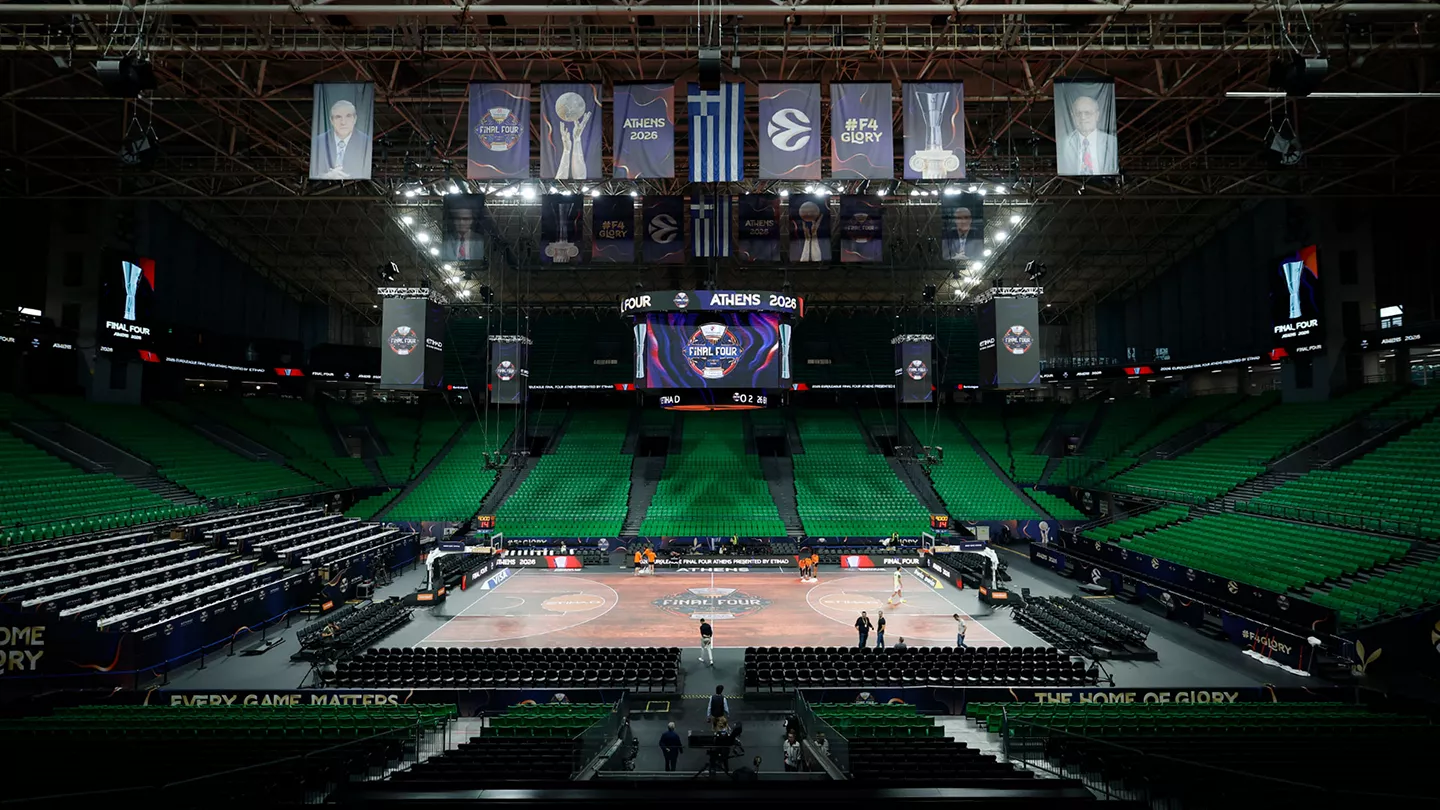
Last week I was in Athens for the EuroLeague Final Four. Olympiacos beat Real Madrid 92-85 in the final on Sunday night, their fourth EuroLeague title, thirteen years since the last one, won in their rival's stadium, in their own city, in front of a crowd that had been building toward that moment all week. Evan Fournier named MVP. The Telekom Center, Panathinaikos' home arena, turned entirely red and white.
It was one of the most electric sporting atmospheres I have experienced. The kind that reminds you, viscerally, why sport holds the place it does in people's lives.
And it was in that environment, ten rows from the court, surrounded by 19,000 people who had completely lost themselves in what was happening in front of them, that something Larry Kestelman said in one of our expert panels landed with a clarity it might not have anywhere else.
Kestelman is the Executive Director and owner of the National Basketball League of Australia, one of the fastest growing basketball leagues in the world. He was speaking as part of the EuroLeague Basketball Institute's expert panel series, a component of the Sports Business MBA program I am completing. What he said was not complicated. But I have not stopped thinking about it since.
He talked about the first 20 meters around the court.
The 20 Meters Nobody Is Looking At
The space between the playing surface and the crowd. Hospitality activations, catering, fan engagement experiences, the physical and commercial real estate that exists in every arena at every game and that most clubs treat as logistical territory rather than strategic opportunity. Kestelman's point was not that clubs are leaving revenue on the table through operational carelessness. It was something more precise than that.
The people making commercial decisions inside sports organizations are often so captivated by what is happening on the court that they stop seeing what is happening around it. The spectacle creates the blind spot. The more extraordinary the product, the more completely it captures the attention of everyone inside the building, including the people whose job it is to think about everything except the product.
That reframe is worth sitting with. Because it means the problem is not a failure of intelligence or ambition or commercial awareness. It is a structural consequence of working in an industry where the product is genuinely exceptional at demanding total attention. The first 20 meters around the court represents an opportunity precisely because it sits in the peripheral vision of an organization whose central vision is almost entirely fixed on what is happening inside the lines.
Every club knows the 20 meters is there. Almost none of them are seeing it clearly.
Why This Happens
People who work in sport almost universally arrived there because they love sport. That love is a genuine asset. It produces commitment that is difficult to manufacture, cultural fluency that outsiders cannot replicate, and a depth of product knowledge that shapes better decisions across almost every function. The person who grew up watching basketball, who understands what a crowd feels before a big game and what a locker room sounds like after a loss, brings something to a sports organization that no amount of business school training fully substitutes for.
But that same love produces a specific and largely unacknowledged vulnerability. When the product you are building around is as emotionally powerful as elite sport, the temptation to orient everything toward the product is almost irresistible. Decisions get filtered through the question of what serves the game rather than what serves the business. Commercial opportunities get evaluated through the lens of whether they feel right for the sport rather than whether they create genuine and durable value. The game becomes the answer to questions it was never designed to answer.
This is not unique to basketball or to European sport. It is a pattern that repeats across every level of the industry, from grassroots clubs to global leagues. The organizations that break out of it are not the ones that care less about the game. They are the ones that developed the discipline to hold the game and the business around it in view simultaneously, without letting the brilliance of one obscure the opportunity of the other.
That discipline is harder to develop in sport than in almost any other industry, for the simple reason that the product keeps giving you reasons to look at it instead of around it.
Where the Blind Spot Extends
The first 20 meters is the most concrete expression of the problem. But the same dynamic shows up in less visible ways across the full commercial and strategic life of a sports organization.
The narrative and positioning work that clubs and organizations systematically underinvest in exists for the same reason. The game communicates so powerfully on its own terms, through results, highlights, individual performances, and the accumulated emotion of a season, that the question of what the organization represents beyond the game rarely receives the sustained attention it deserves. When results are good, the game does the communicating and the absence of a clear organizational identity is invisible. The club seems coherent from the outside because it is winning, and winning creates the illusion of clarity.
When results fluctuate, as they always eventually do, the illusion dissolves. A key player leaves and suddenly nobody can articulate what the club stands for without that player. A run of poor form exposes the fact that the communication was never anchored in anything more stable than momentum. A sponsor asks what the organization represents and the answer gets complicated faster than anyone expected. The blind spot that exists around the court also exists in the boardroom, the communications department, and every room where decisions are made about what the organization is and how it presents itself to the world.
The game is not the answer to those questions. It is the context within which they become urgent. The organizations that mistake one for the other find themselves rebuilding from scratch every time the context changes, which in sport means every season, every transfer window, every time a result goes the wrong way on a Saturday that nobody saw coming.
Partnership, Hospitality, and the Opportunity in the Periphery
Kestelman's NBL is instructive here because it has had to solve this problem more deliberately than most European leagues. Building a basketball league in a country where cricket and Australian rules football dominate requires a specific kind of commercial creativity, the ability to make every element of the experience count because you cannot rely on the game's cultural weight to do the work for you.
The result is an organization that has thought carefully about exactly the spaces that more established leagues tend to ignore. The hospitality layer around NBL games, the engagement activations, the partnership integrations that feel like part of the experience rather than interruptions to it, are not accidental. They are the product of an organization that learned early that the first 20 meters matters as much as the last two minutes.
That lesson is transferable to any sports organization willing to look at what is sitting in its peripheral vision. The commercial opportunity in sport is not only inside the lines. It is in the atmosphere around the game, the experience of arriving and leaving, the moments between the action, the spaces where fans exist as people rather than as spectators. Clubs that design for those moments rather than defaulting to whatever fits in the space are the ones that build something that compounds beyond the result on the scoreboard.
What Seeing Clearly Requires
The practical implication of Kestelman's insight is not that sports organizations should care less about the game. The love of the game is not the problem. It is, in many ways, the foundation of everything worth building in sport.
The implication is that the people responsible for building the business around the game need to develop a specific and deliberate discipline: the ability to step back from the spectacle far enough to see the full picture of what the organization is, what it represents, and where the value actually sits. Not once, in a strategy offsite or an annual review, but consistently, as a way of operating that runs alongside the daily reality of working in an environment where something extraordinary keeps happening and demanding your complete attention.
That discipline requires a clarity about organizational identity that most clubs have not fully developed. You cannot see the commercial opportunity in the periphery if you do not know what you are looking for. The first 20 meters around the court is not just physical space. It is an expression of what the club believes about the experience it is creating and the relationship it has with the people inside the building. Organizations with a clear enough sense of what they represent can design that space deliberately. Organizations without it fill it with whatever fits and move on.
The blind spot is not just about revenue. It is about identity. And the clubs that learn to see around it are the ones building something that extends well beyond what happens between the lines.
Athens
Sitting in the Telekom Center on Sunday night, watching Olympiacos celebrate a title thirteen years in the making in their rival's stadium while the city outside turned red and white, it was easy to understand why the game captures everything. It deserves to. What happens on the court at the highest level of European basketball is genuinely extraordinary, the product of years of investment, development, competition, and the specific kind of human excellence that sport produces better than almost anything else.
And it was exactly there, in the middle of that atmosphere, that Kestelman's point felt most true. The spectacle was total. The blind spot it creates is proportional to that totality. The organizations that learn to hold both in view at the same time are the ones that build something worthy of the game they are building around.
The first 20 meters is where that starts. But it does not end there.