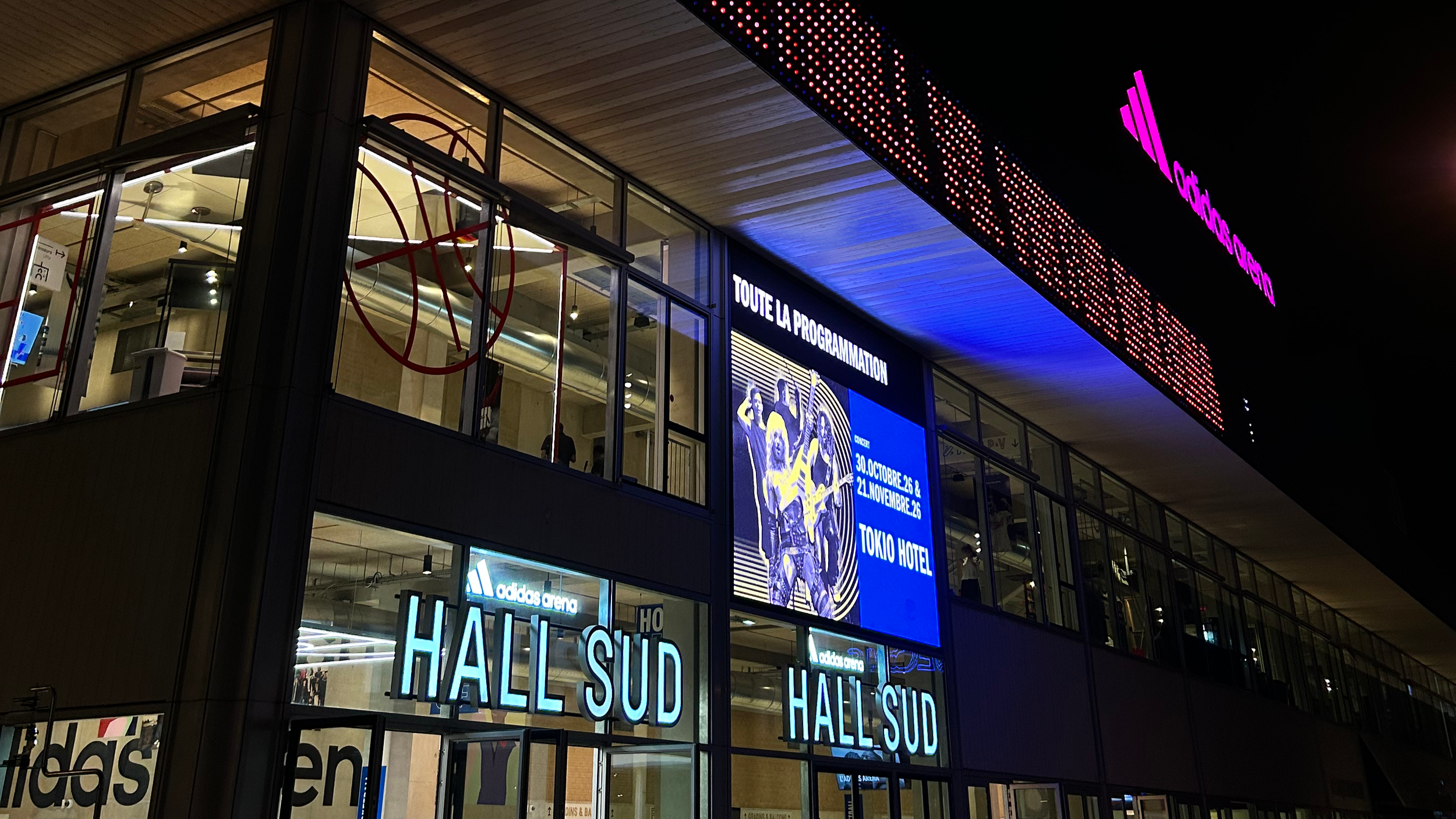
On Wednesday I drove to Paris, arrived around 6 pm, checked in at my Airbnb and walked into the center to watch the Eiffel Tower shine for a while before heading to the Adidas Arena for Paris Basketball against Virtus Bologna in round five of the EuroLeague. It was a short trip with a simple purpose, which was to see how this club presents its game, and it left me with a clearer idea than I expected of how much a market’s history shapes the product a club can build.
The game was a good one, with Virtus winning 96-94 after a finish that came down to the final possession, its first win over Paris in five EuroLeague meetings. Paris played without Nadir Hifi, the league’s top scorer, and had lost by the same margin to ASVEL the week before, so I am careful not to read too much into a single evening. What stayed with me was the friendly atmosphere.
The room
The arena looked well filled, and the crowd was a mix of high-schoolers, young couples, groups of friends, students and parents with their kids, a good cross-section of a city out for an evening. An announcer worked to lift the energy and there were activities during timeouts and at halftime. The crowd took part willingly, so none of it felt forced, people made noise and were engaged.
Still, the passion did not seem to come from the fans on their own, because they had come to watch a basketball game and enjoy an evening, hoping Paris would take the win. In the places I’ve gotten to know this year, in Bologna, Athens and Kaunas, the feeling starts in the stands and the production follows it, while in Paris the production invited the crowd in and the crowd came along gladly. I knew from watching Paris on television that it is not Belgrade, Athens or Istanbul, but standing in the building made the difference concrete. It felt closer to the one NBA game I have seen, the Knicks against the Nets at Madison Square Garden last year, a family-friendly night built to be a great evening out, than to the basketball I know as a matter of devotion.
I always stay after the final buzzer to watch how an arena empties, what happens on the court and how people talk to each other on the way out, since it teaches me a great deal about a product. On Wednesday people left in good spirits, there were conversations on the court and some moments between players and fans. The result, a narrow home defeat, did not seem to dominate the mood.
Eight years against almost a hundred
Part of the explanation sits in history. Paris Basketball was founded in 2018 by David Kahn, a former Minnesota Timberwolves executive, and Eric Schwartz, with the ambition of bringing elite basketball to the city, and it has built quickly, winning the EuroCup in 2024 and earning a place in the EuroLeague that way. Its home, the Adidas Arena, was built for the 2024 Olympics and opened that February with room for 8.000. A club that young has had no time to gather generations of supporters who inherited their loyalty, so what it offers today is a well-produced evening for a large and varied audience that is still being built.
Two weeks earlier I had been in Bologna for Virtus, a club founded in 1927, whose hall sits inside a residential neighborhood, and which I described in “Virtus Bologna at the PalaDozza: What a Live Game Reveals.” The two clubs play in the same league, for the same title, with the same kind of players, and yet each city has built a different product because the history behind each is different. Neither is better, and neither can simply be borrowed from the other.
One league, several products
The EuroLeague has always held more than one kind of club, and the difference becomes easier to see as the league works toward expansion and adds markets with their own histories. Paris is also among the cities named in reporting on where NBA Europe teams could be placed, and the product I saw there resembles the one I experienced at Madison Square Garden, an evening built around entertainment for a broad audience. Where any club ends up is a separate question, which I looked at in “NBA Europe vs EuroLeague: What the Valuation Fight Reveals,” and what Paris shows for now is that both kinds of product already exist inside the same league.
What it means for clubs
For a club, the useful question is which product it is and what that product needs in order to grow. A club built on devotion has a meaning that is strongest at home, so its challenge is to make that meaning travel to people who have never been in its arena. A club built around a fun night out has an audience that arrives easily, so its challenge is to give people a reason to come back whatever the result and to help a bond form that goes beyond a good evening. Both challenges are long, and each club faces them with the history it has, Bologna with almost a hundred years and Paris with eight, and what makes the difference is how well each one understands what it has.
After the buzzer
I came back with the lesson staying after the buzzer usually gives me, which is that a product is easiest to see once the game is over. The score ends up in the record books, while what the arena looks like as it empties, what people say to each other and how they feel as they leave is the clearest picture of what a club has built. In Paris, it was a city that had enjoyed its evening and was ready for the next one. In Bologna, two weeks earlier, it was a crowd that had lived through something together. Both are real, and both are made of the history their clubs have.