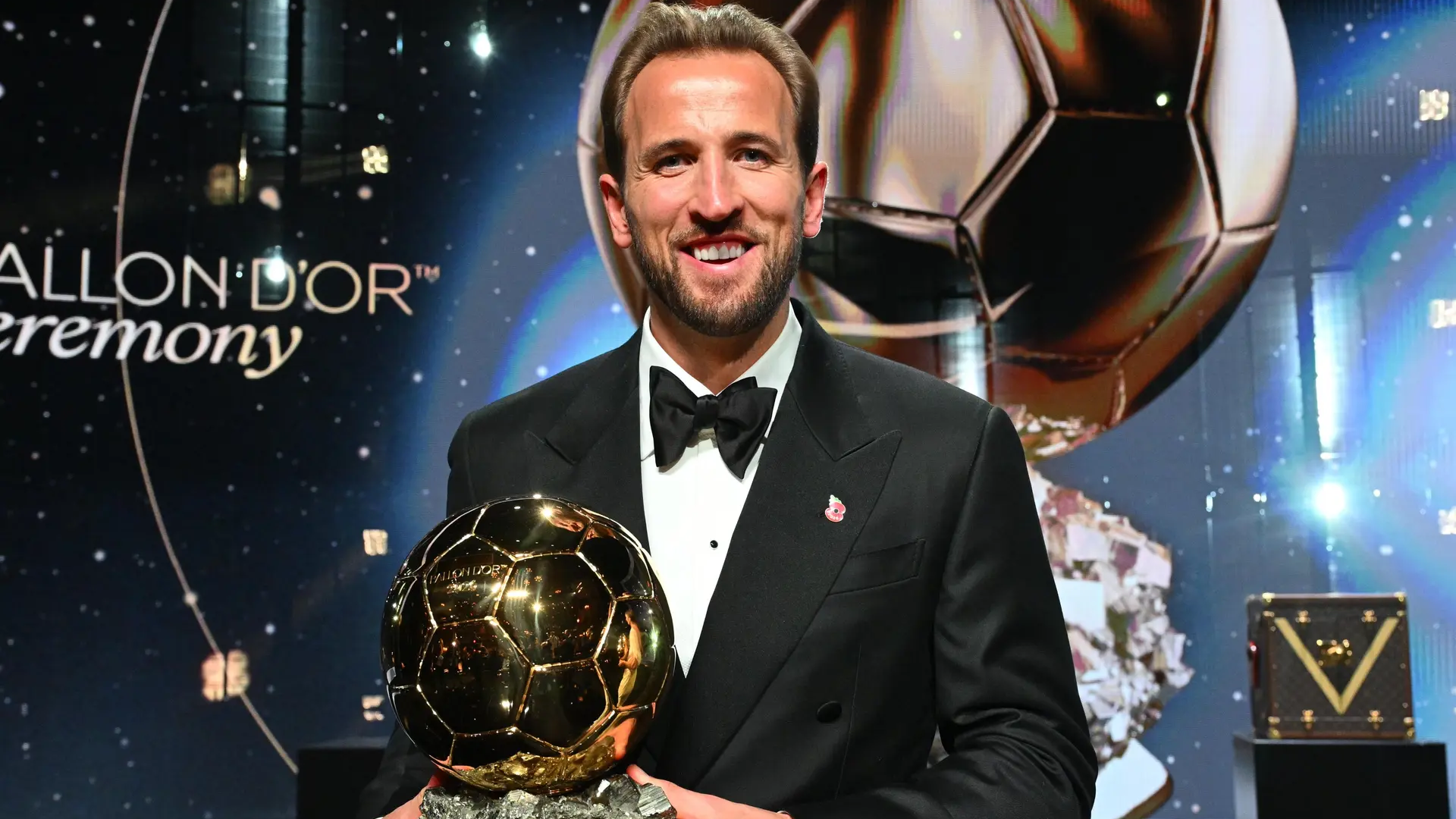
On Monday night at the London Palladium, in the first Ballon d’Or ceremony held outside France and seventy years after Stanley Matthews won the first one, Harry Kane was named the best player in the world. At 33 he is the first Englishman to win it since Michael Owen in 2001 and the first Bayern Munich player to win it since Karl-Heinz Rummenigge in 1981, and he won by fewer than 41 points over Kylian Mbappé, a margin France Football’s editor-in-chief Vincent Garcia said was smaller than the 41 points that separated Rodri and Vinícius Júnior in 2024. Garcia told L’Équipe that he followed the results in real time during the month of voting, that Mbappé led for a long time, and that Kane came back into contention before a very small number of points decided it.
Whether Kane deserved it will be argued for weeks, and his numbers make a strong case. What interests me more is what the road to this award shows about how stories move in sport, because it is a clean example of a story that lagged behind the evidence for years and then caught up.
A vote made of a hundred private pictures
The Ballon d’Or is decided by 100 journalists, one for each of the top 100 nations in the FIFA rankings. Each of them ranks ten players from a shortlist of 30 put together by the editors of France Football and L’Équipe, a member of the previous jury and the UEFA ambassadors Luis Figo and Fabio Capello, and the ten places are worth 15, 12, 10, 8, 7, 5, 4, 3, 2 and 1 point. The official criteria are individual performances, team performances and achievements, and class and fair play, and published guides to the vote say that career achievements stopped counting after a revision in 2022.
On paper the vote looks at a single season. In practice each voter carries a picture of every player into that season, built up over years from whatever they have read, watched and heard, and the season has to change that picture before it changes the vote. Seen this way a story is a hundred private pictures, each updating at its own pace, which is one way to understand why Kane’s took as long as it did to move.
The same tally, a different outcome
In his first season at Bayern Munich, 2023/24, Kane scored 36 Bundesliga goals, more than any other player has scored in a first season in the league, and finished tenth in the 2024 Ballon d’Or with 201 points. In 2025/26 he scored 36 Bundesliga goals again, and this time he won. The comparison is not perfectly fair, because 2025/26 was a bigger year in every respect, with 73 goals and eight assists in 65 games for Bayern and England, but the league tally is the same, which makes it a useful place to ask what else changed.
Kane understood the rules of the story he was in earlier than most. In his first season in Germany he told The Guardian that great seasons without a team trophy at the end of them keep a player out of the Ballon d’Or conversation, which was his own explanation for why his goals at Tottenham had earned so little recognition. In the spring of 2025 he won his first major trophy, the Bundesliga, and said people would now have to find something else to talk about, yet the vote that September placed him thirteenth with 112 points, behind two Paris Saint-Germain full-backs and his England teammate Cole Palmer. England manager Thomas Tuchel said the ranking should have been higher, while adding that he was not a big fan of individual awards in a team sport.
In November 2025 Kane told reporters, as Reuters reported, that he could score 100 goals in a season and still not win the Ballon d’Or without the Champions League or the World Cup, and that major trophies were what counted. Then 2025/26 happened. He scored 36 league goals, 10 in the German Cup including a hat-trick in the final against Stuttgart, and 14 in the Champions League, second only to Mbappé’s 15, as Bayern won the Bundesliga, the cup and the Supercup. At the World Cup he scored six goals as England reached the semifinals, lost to Argentina and finished third, their best result since 1966. He won neither of the two prizes he had named, since Bayern lost the Champions League semifinal to Paris Saint-Germain, and he won the Ballon d’Or anyway, which suggests that by then the old label had moved further than Kane himself expected.
What the final weeks show
Garcia’s account of the vote adds a detail that is easy to miss. For weeks the favorite was Mbappé, whose season Garcia called exceptional by every measure, and the lead changed hands late. The story was still moving while voters were making up their minds, and the gap between first and second place was small enough for a handful of voters to decide it.
The same logic worked against the players who finished behind him. Spain won the World Cup, yet Garcia said Rodri took votes away from Lamine Yamal, since the Spanish support split between them, and that the split cost them a great deal. A team’s story with two protagonists is harder to vote for than one with a single clear lead, even when the team has won the biggest prize, and with 100 voters it takes only a small difference in emphasis to spread the points.
Why a story moves slower than the evidence
A label is a shortcut, and a shortcut stays in use until enough new evidence arrives to make it feel wrong. That takes repetition, because one result can always be explained away as an exception, a good season in a strong team or a lucky run, while a second season that points the same way is much harder to dismiss. A single Bundesliga title in 2025 was read as one data point, and a double plus a Supercup, a deep Champions League run and a World Cup semifinal in 2026 was read as a pattern.
Context matters as well. While Kane was still at Tottenham, former England striker Emile Heskey said that a club competing for major honors every season would have put him in the Ballon d’Or conversation alongside Benzema and Lewandowski. Kane’s goalscoring was already at an elite level, and what changed when he moved to Bayern in 2023 was the setting in which that output could turn into trophies. The cost of the lag was time, since at 33 he is the fourth-oldest first-time winner of the men’s award, according to NBC Sports, which means the story took most of a career to turn.
What athletes in any sport can take from it
Four things follow for athletes in any sport. The first is to know the label you carry and to be able to say it in plain words, as Kane could. The second is to know what evidence would retire that label and where it can be produced, because a setting that cannot produce the proof will keep the label alive. The third is to expect a lag, since one proof is rarely enough and the plan has to cover the repetition that follows. The fourth is to keep the origin in the story, which is what Kane did on stage.
After Victor Wembanyama’s playoff debut I wrote about how, when the moment arrives, the work is already done, and Kane’s path is the long version of that idea. The work of 2024 was already visible in the goals, and the years after it were about accumulating enough evidence, in the right setting, for the story to change.
Where the story began
In his speech Kane said he wouldn’t be where he is today without Tottenham, the club he joined at 11, and he thanked a long list of coaches, from the Tottenham academy to Pochettino, Mourinho and Southgate, along with his family. He told his England teammates it had not been a perfect year but that they had built a great one together. It is easy to treat a speech like this as ritual, and in this case it carries the point, since a story that changes keeps its origin, and the label he spent years carrying was part of what gave this award its weight.
Same league goals, different story. Kane’s story changed because the evidence kept arriving, in a setting where it could, until the old label had nowhere left to stand, and the athletes who understand that begin gathering evidence, and deciding what it should add up to, long before the vote.