When the Moment Arrives, the Work Is Already Done
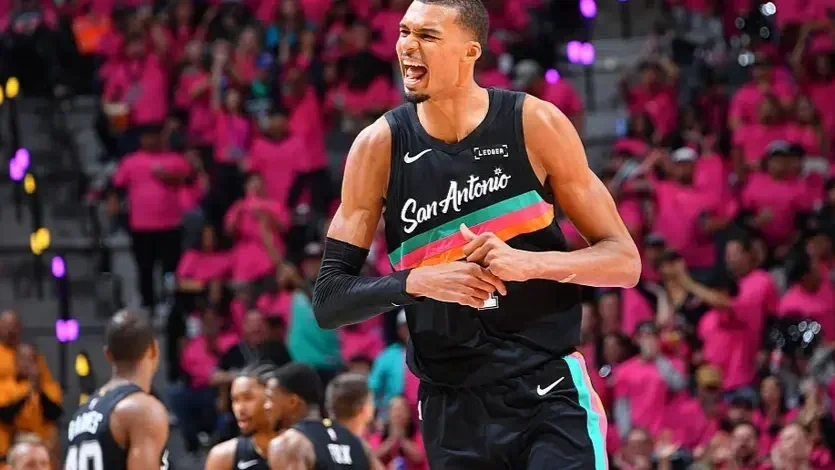
Two days. That is how long it took for Victor Wembanyama to score 35 points in his playoff debut, break a franchise record held by Tim Duncan, and become the youngest unanimous Defensive Player of the Year in NBA history.
The numbers are historic. But the more interesting question is not what happened. It is why none of it looked like a surprise.
Wembanyama said something before Game 1 that is worth holding onto. "The first time I stepped on the court, even for warmups, I felt the atmosphere was different." Not that it was overwhelming. Not that he needed to adjust. Just that it was different, and that he had already registered that difference and filed it away before the ball was tipped. That is a specific kind of readiness. It is not the readiness of someone who has been told they are capable. It is the readiness of someone who knows exactly what they are walking into because they have been building toward it deliberately for years.
That distinction matters more than most post-game analysis will capture.
What the transition moment actually demands
Every athlete in professional sport faces a version of the same crossroads. The moment where the context changes permanently, where what was expected of them shifts, and where the question is no longer how talented they are but who they are when it counts the most.
For NBA players, the playoff debut is one of those moments. It is the first time the stakes are different in a way that the regular season cannot replicate, where every possession carries consequences that compound over a series, where the opponent has had weeks to prepare specifically for you, and where the margin for confusion about your own identity narrows to almost nothing.
Some athletes arrive at that moment hoping it will define them. They perform well in the regular season, they carry their talent into the postseason, and they wait for the pressure to reveal something about themselves that they have not yet fully understood. Sometimes it does. More often, the uncertainty shows.
The athletes who navigate transition moments most effectively are the ones who arrive having already done the harder work. Not just the physical preparation or the tactical study, but the foundational work of understanding clearly what they represent, what their game is built around, and what they are there to do regardless of how the opponent adjusts or how the crowd responds. Wembanyama's demeanor on Sunday, his own words, and the quality of his performance all pointed to someone in that second category. He was not discovering who he was under pressure. He was confirming what he had already established.
What unanimous actually means
The Defensive Player of the Year vote deserves more attention than the headline typically gets. All 100 first place votes from a panel of media members who watch basketball professionally, who cover different teams, who approach the game from different angles and with different biases, and who could not find a single reason to put someone else first.
Unanimity of that kind is not a statistical outcome. It is a statement about legibility. When 100 people who cover the sport for a living cannot find grounds for disagreement, it means the identity of what a player represents has become clear enough that debate is no longer useful. There is no argument to have because the answer is too obvious to contest.
That clarity does not arrive automatically with talent. Plenty of talented players generate debate precisely because what they represent is not yet settled, because their game is still searching for its most coherent expression, because observers see different things depending on which night they watch. Wembanyama has been building toward this kind of legibility since his rookie season. The unanimous vote is the evidence of something accumulated, not something sudden.
He joined Michael Jordan and David Robinson as the only players to win both Rookie of the Year and Defensive Player of the Year. Tim Duncan and David Robinson were sitting courtside when he broke Duncan's franchise record for points in a playoff debut. The Spurs became the first franchise with four different DPOY winners. Every layer of historical context pointed in the same direction. This was not a surprise. It was a confirmation.
The gap between promising and proven
The transition from promising to proven is one of the most consequential crossroads in an athletic career, and one of the least discussed in terms of what actually determines how it goes.
Performance matters, obviously. But performance alone does not explain why some athletes cross that threshold with the kind of clarity Wembanyama displayed this week, while others with comparable talent spend years in the space between potential and definition. The difference is rarely physical. It is identity-based.
Athletes who carry a clear enough sense of what they represent into transition moments, who have done the work of understanding what their game is built around and what makes them distinct, carry themselves differently when the stakes change. The pressure does not rewrite them because there is already something stable underneath it. They adapt tactically without losing coherence. They absorb the difficulty without losing direction.
Wembanyama has been remarkably consistent about what he is building and why. Since before his first NBA game, the way he has spoken about his development, his craft, his standards for himself, has pointed toward someone with an unusually clear sense of identity for his age and stage. That clarity is not separate from his on-court performance. It is part of what produces it.
The athletes who struggle through transition moments are often not lacking in talent or even in preparation. They are lacking in that foundational clarity. They arrive at the crossroads without a clear enough answer to the question the moment is asking, and the uncertainty shows in ways that statistics do not always capture but that observers invariably feel.
The work before the moment
What made Wembanyama's week possible was not something that happened between Sunday and Monday. It was something built across three seasons, across thousands of decisions about how to develop, what to prioritize, and what kind of player and person to become.
The playoff debut and the DPOY award are not the beginning of something. They are the evidence of something already constructed. The foundation was laid before anyone outside of San Antonio was paying close attention. By the time the moments arrived, the only question was whether the performance would match the preparation. It did, unanimously.
This is the pattern that separates athletes who navigate transition moments well from those who struggle through them. The work is not done during the transition. It is done before it. The clarity that carries an athlete through a defining moment, the stable sense of identity that holds its shape under pressure, is built in the periods that feel less significant, in the choices made when nobody is watching and the stakes are low enough that taking the long view feels optional.
For most athletes, the transition moment they are building toward is not the NBA Playoffs. It is a first professional contract, a move to a new league or country, a step up in competition that changes what is demanded of them, or simply the moment where everything they have been working toward finally arrives and they discover whether the foundation they built can hold the weight.
The athletes who navigate those moments the way Wembanyama navigated his are the ones who treated the identity work as seriously as the physical work long before the moment required it. Not because they knew exactly when the moment would come, but because they understood that when it did, the preparation would either be there or it would not. There is no substituting for it in the moment itself.
Wembanyama knew before the warmup that the atmosphere was different. That knowledge came from somewhere. It came from the work.