Four Series. Four Identities. One Destination
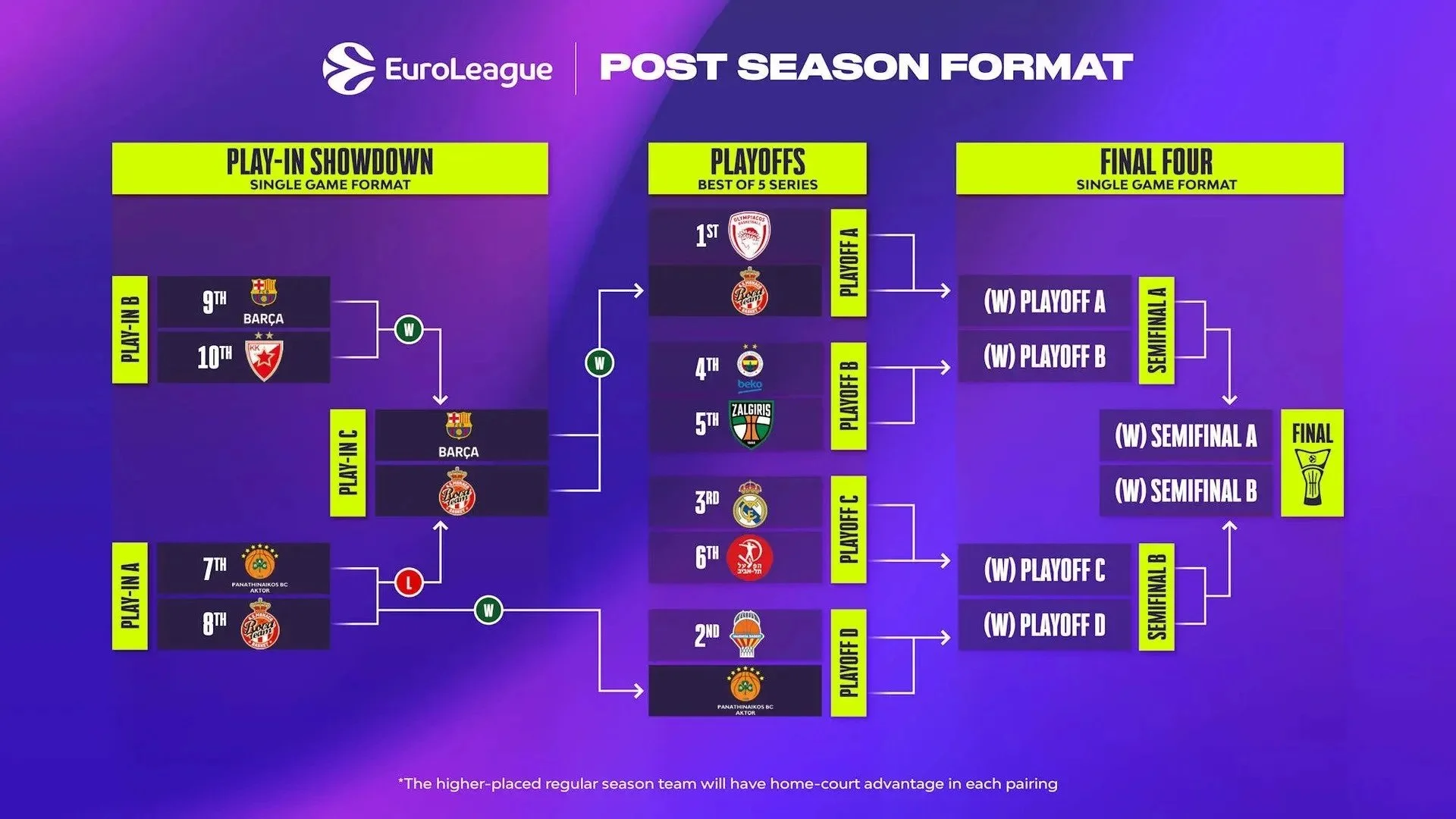
Two days ago, the 2026 EuroLeague Playoffs began. Four best-of-five series, eight teams, one destination: the Telekom Center in Athens on May 22. The Final Four will be decided on the court. But before a single series is settled, each matchup is already carrying a narrative that reveals something more fundamental than form or statistics. It reveals how these organizations understand themselves, and whether that understanding is strong enough to hold its shape when the pressure of the highest stakes European basketball has to offer becomes impossible to ignore.
That is what the playoffs do that the regular season cannot. Thirty-eight games allow for recovery, adjustment, averaging out. A best-of-five does not. Every decision, every response to adversity, every moment of clarity or confusion under pressure becomes visible in a way that a long season obscures. The teams that reach Athens will not just be the most talented. They will be the ones whose identity held when everything else became uncertain.
Each of the four series tells a different version of that story.
Olympiacos vs Monaco: Identity Under Siege
Olympiacos built the most coherent organizational identity of any team in this field across the 38 games of the regular season. They finished first. They were the only team to rank in the top three in both offensive and defensive efficiency simultaneously. They won nine consecutive home games. Their identity is legible and specific: collective discipline, defensive fortress, home court as a genuine strategic asset rather than just a statistical advantage.
And yet Monaco beat them twice in the regular season. Then eliminated them in last season's semifinals. The visitors arrive as the eighth seed, having survived the Play-In, carrying none of the weight that comes with being number one. They have beaten this specific opponent more recently and more convincingly than the seedings suggest.
The story here is not about talent. It is about what happens when a clearly defined identity meets a team built specifically to disrupt it. Olympiacos knows exactly what it is. The question the series asks is whether that clarity is strong enough to hold when a team that has studied and beaten it arrives with nothing to lose and a specific blueprint for doing it again.
Mike James adds a personal layer. Left off the All-EuroLeague teams despite a season that most observers felt warranted inclusion, he arrives carrying something beyond tactical motivation. An athlete with a clear sense of what he represents and a genuine grievance about how he has been understood by the people evaluating him. That combination, identity clarity plus external slight, has a way of producing performances that change series.
Valencia vs Panathinaikos: System Against Personality
Pedro Martínez won EuroLeague Coach of the Year this season. The award reflects something real about how Valencia operates: structured, consistent, defensively relentless, built around a system clear enough that every player understands their role within it. Valencia beat Panathinaikos twice this season, including by 18 points at Roig Arena. Their organizational identity is one of the most coherent in the bracket.
Ergin Ataman's Panathinaikos is built on something fundamentally different. Personality, unpredictability, offensive creativity, and a coaching presence that shapes the emotional atmosphere around his team as deliberately as any tactical decision. His pre-series comment, that Valencia could beat the LA Lakers, was met with cool dismissal by Martínez. That exchange is not just mind games. It is a window into two organizations that understand themselves in almost entirely opposite ways colliding at exactly the moment when those self-understandings are tested most severely.
What makes the series genuinely interesting is that Panathinaikos since March 1 has been the most efficient offensive team in the entire competition, scoring 1.11 points per possession. The system met the personality, and the personality caught fire at exactly the right time. Whether that momentum represents a genuine identity shift for Panathinaikos or a hot streak that Valencia's defensive structure will cool is the central question of this series.
The sideline battle between Martínez and Ataman will be as revealing as anything happening on the court. Two coaches with entirely different ideas about what a team should be, and two organizations whose identities reflect those differences all the way down.
Real Madrid vs Hapoel: The Weight of History Against the Freedom of Nothing to Lose
Real Madrid's identity in European basketball is the most historically loaded of any club in this field. The badge carries the accumulated weight of decades of success, expectation, and institutional prestige that shapes how players perform under pressure before a single defensive possession is played. Their home record this season, 18-1, reflects how completely they have channeled that identity into a tangible competitive advantage. Walter Tavares, named to the All-EuroLeague Second Team this season, is now level with Juan Carlos Navarro on career All-EuroLeague selections. Identity accumulating through consistency over years, becoming part of the club's historical fabric.
Against them, Hapoel, who claimed more road victories than any other team in the regular season. A club with no comparable institutional history in European basketball, no expectation to manage, no badge whose weight might become a burden when a game hangs in the balance in the fourth quarter of a deciding fifth game. Dimitris Itoudis's team is adaptable by design, built to function effectively in environments that should disadvantage them, which is precisely what away games in a Real Madrid playoff series represent.
The narrative question this series asks is one of the oldest in sport: what is the competitive value of institutional identity, and what happens when it meets a team that has none of that weight to carry and uses that freedom as fuel?
Fenerbahce vs Zalgiris: Champions Under Pressure From Within
This is the sharpest narrative in the bracket, and the one that connects most directly to what the playoffs reveal about organizational identity.
Fenerbahce are the defending champions. Of all the teams in this field, their narrative position should be the most stable. They know what winning at the highest level looks like. They have done it. Their identity as champions is the most recently confirmed of any club here.
And yet they arrive at the playoffs having lost five of their last six regular season games. They barely held home court advantage in the standings. Zalgiris beat them twice this season, including in Istanbul in March. The Lithuanian team arrives in better form, with more momentum, and with a specific tactical blueprint for defeating this specific opponent.
The coaching subplot sharpens everything. Sarunas Jasikevicius coaching Fenerbahce against Tomas Masiulis, his former assistant, seven years working together on the same staff before Masiulis took the Zalgiris head job. Both coaches know each other's tendencies in a way that goes beyond scouting reports. The tactical chess match between them will be conducted between two people who understand each other at a level most playoff opponents never reach.
What the series actually asks is whether Fenerbahce's championship identity is a genuine foundation that will stabilize them under pressure, or whether it has become a narrative they are carrying rather than a reality they are currently living. The defending champion who arrives at the playoffs in poor form is not just facing a tactical challenge. They are facing an identity question: are we still what we were, and if not, what are we now?
What Athens Will Reveal
Four series. Four different versions of the same fundamental question: how clearly does this organization understand itself, and is that understanding real enough to hold its shape when the margin for ambiguity disappears?
The regular season allows organizations to obscure the answer to that question behind volume and variance. The playoffs do not. Best-of-five basketball strips away everything except what is genuinely there. The teams that reach Athens on May 22 will not just be the most talented or the best prepared tactically. They will be the ones whose identity, as organizations and as groups of individuals, proved durable enough to survive the specific pressure that each of these series will generate.
That is what makes the EuroLeague playoffs the most revealing moment in the European basketball calendar. Not the highest stakes. The highest clarity. Everything the regular season allows teams to defer gets answered here, on the court, in the moments that cannot be averaged away.
The narratives are already written. The results will tell us which ones were true.